
Good Housekeeping's desk-organization ideas include a narrow hutch, upper cabinets, wire baskets and a hook board. Open storage keeps selected items visible, while closed compartments provide somewhere for equipment and supplies that do not need to remain on display.
Choose the format around what must be stored and how often it is used. A headphone hook or note grid can remove small objects from the desktop without creating a large furniture addition. Secure wall-mounted storage appropriately and preserve clear access to the screen, lights and power connections.
Give frequently used items a reachable place
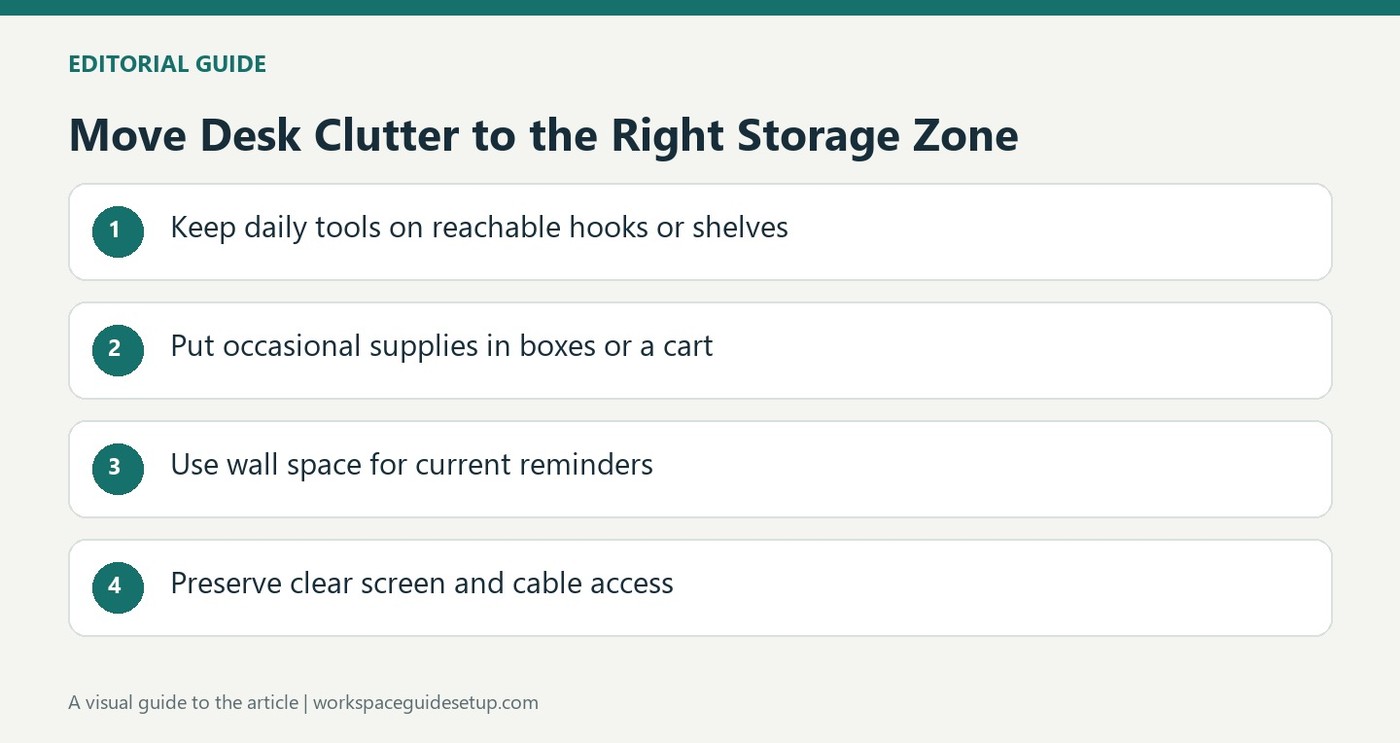
The source's hook-board example stores headphones vertically, while a metal rail with S-hooks can carry a pen cup, scissors or a small basket. These move everyday tools away from the main surface without putting them behind a closed door. Check the mounting method and supported load for the actual wall and fittings. Avoid reaching over a monitor or exposed cables every time an item is needed.
Move occasional supplies farther from the desk
Document boxes, a nearby rolling cart and closet storage are different ways to relocate supplies that do not need a permanent desktop position. The article explicitly notes that a desk organizer need not live on the desk. Group those items by use so moving them out of sight does not make them harder to retrieve. Keep walking space clear when adding floor baskets or a cart.
Use the wall for information as well as objects
A wire grid can display notes with small clips, while a chalkboard calendar or glass whiteboard provides another place for reminders. These serve a different purpose from storage shelves. Choose the information that needs to remain visible and remove outdated material as part of the routine. The illustrated designs are organization ideas, not proof that a particular color or symmetric arrangement increases productivity for every user.
Assign wall storage by how often the object is handled
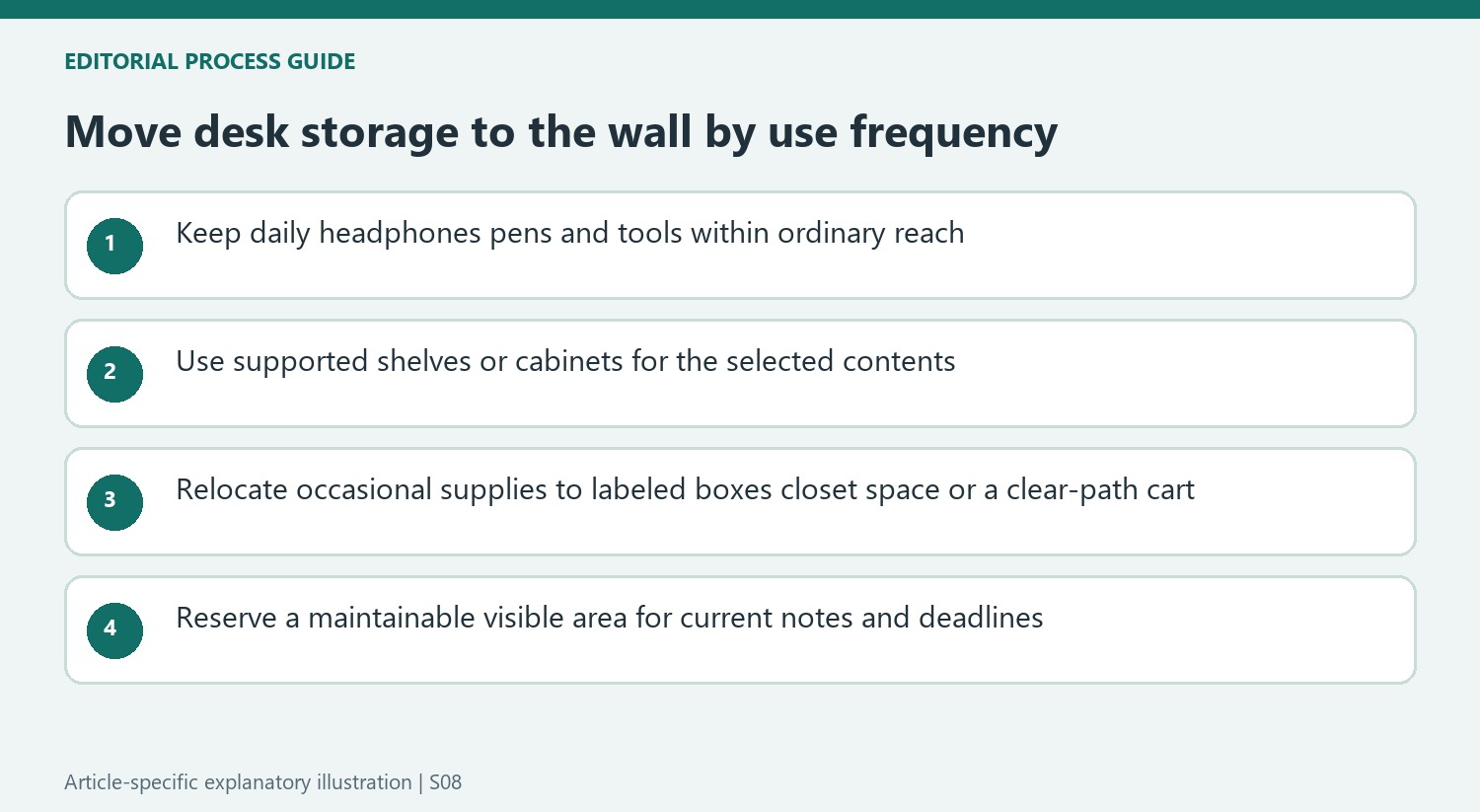
The guide's hook board holds headphones vertically, while a metal rail and S-hooks can carry a pen cup, scissors or a small basket. Those ideas move daily tools off the surface without putting them out of sight. Choose positions within ordinary reach and check the actual mounting method and load. Reaching over a screen or pulling an item through hanging cables can make visually neat wall storage less useful than a small clear desktop area.
Open shelves and narrow hutches offer another kind of visible storage, while a cabinet can conceal less attractive supplies. Match the format to the contents rather than using an open shelf for everything merely because it appears lighter in a photograph. A stable wall-mounted object still needs suitable support for the real wall construction. Follow the chosen fitting's instructions and keep lighting and monitor adjustment clear of the storage structure.
Move occasional supplies farther away without losing their identity
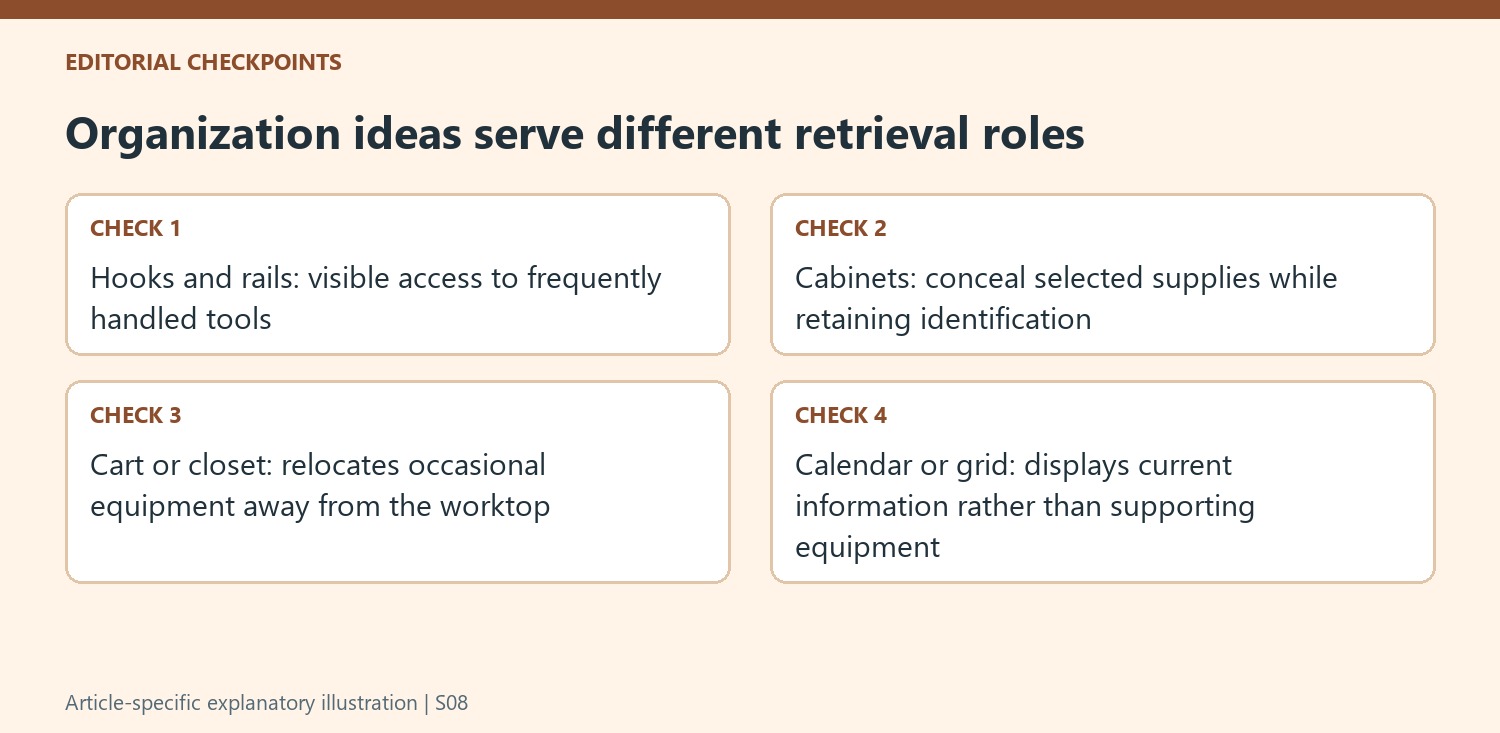
The source explicitly notes that a desk organizer does not have to remain on the desk. Document boxes, closet shelves and a nearby rolling cart can hold equipment used less often. Group those items by task so they remain easy to find after relocation. Concealment is useful only if a particular cable, notebook or supply can still be retrieved without unpacking several unrelated boxes.
A cart should remain convenient to move without blocking walking space or the chair's normal path. Floor baskets likewise need an appropriate position rather than simply taking the clutter from the worktop into the foot area. Select the storage volume after reviewing what is actually kept. That makes vertical or remote storage an extension of the working routine instead of another reason to retain supplies with no defined use.
Distinguish visible information from stored equipment
A wire grid displaying clipped notes, a chalkboard calendar and a glass whiteboard provide information surfaces rather than the same storage function as a shelf. Decide what needs to stay visible during work and remove outdated reminders. A wall covered with old material can remain distracting even when no physical object occupies the desk. The right information area is the one that can be read and updated easily from the actual position.
The guide's symmetry and color examples are decorative ideas rather than measured productivity results. Use them after determining reach, support and content. Repeated finishes or coordinated boxes can make mixed storage look coherent without requiring every item to be mirrored. The central work zone should retain enough room for the screen, inputs and current paper task. Wall and nearby storage succeed when they give selected objects and information a clear accessible home while preserving that space.
References
- The Best Desk Organization Ideas for a Tidier, More Productive Workspace. Good Housekeeping; Amanda Garrity; Alyssa Gautieri.


Bir Cevap Yaz
E-posta adresiniz yayınlanmayacak. Gerekli alanlar * ile işaretlenmişlerdir.